Pennine Waterways News

Showing posts with label Wigan. Show all posts

Wednesday, 1 April 2015

Inclined Plane Plan for Leeds and Liverpool?

An exciting proposal has been made that would replace part of the notorious Wigan Lock Flight with an inclined plane boat lift.

It is believed that many boaters are put off visiting the Leeds and Liverpool Canal by the prospect of the 21 lock flight between the junction of the Leigh Branch and Wigan Top Lock. Many of the gates are heavy to operate and there are sometimes problems with low water levels, leaking gates, etc.

A scheme put forward suggests replacing the top thirteen locks with an inclined plane that would carry boats on cradles or in caissons mounted on rails. These 13 locks are fairly close together and the canal drops 118 feet (36 metres) in just one mile.


Example of an inclined plane using a cradle on the Elbląg Canal. Photo: Wsombeck at de.wikipedia

The plan would see two cradles running on a single track, with a passing place at the midway point. The cradles would be drawn by a cable. Each cradle would include a water tank that can be filled for the downward journey, so that the extra weight would help to pull the other cradle upwards, reducing the power of the motor required to haul the cables.


Example of an inclined plane with cable-hauled cradle on the Elbląg Canal. Photo: Wsombeck at de.wikipedia

At each end of the plane, the track would slope into the water so that boats can be floated on and off the cradles. It would only take around 20 to 30 minutes for a boat to travel the length of the incline, compared with the 2 hours or more taken to do the 13 locks.

There are a number of examples of systems like this operating successfully in Europe. Most of these inclined planes run in a straight line but there are examples of some that have slight curves built in, and the plane at Wigan would require two slight curves if it was to follow the existing line of the locks.


Example of a curved inclined plane at Dahme Umflutkanal. Photo: Botaurus Stellaris via Wikimedia Commons

The scheme could pay for itself over a longer period through savings in the cost of maintaining the 13 locks it would replace. Boaters would then only be faced with the 8 locks below Rose Grove, attracting more boaters to use the canal, bringing increased revenue for businesses along the route.

The inclined plane, as it would be the only one operational in Britain, could also become something of a tourist attraction in its own right and see tourists once again flocking to Wigan.

The idea is being promoted by The Wigan Incline Trust (T.W.I.T.) who are hoping for backing from local businesses which could benefit from a renewal of the area.

The head of the Canal and River Trust's Blue Sky Thinking section, Maureen Wring, said that this re-affirms the Trust's commitment to boaters. "We are calling it the Leeds and Liverpool Lockless Level Line Lift," she explained. "We hope there will be a trip boat giving tourists rides on the plane. Local tourism bosses are drawing up proposals for a Plane Incline Experience, or P.I.E. Wigan is famous for its pies."

However, Joe Kerr, of the Friends Of Old Lancashire, is not happy and feels the plane will change the character of the historic lock flight: “It will change the character of the historic lock flight,” he told us. “I am not happy.”

The plans are to be unveiled at an exhibition that will be open this morning until mid-day. For more details see here.

Note: The proposed inclined plane is not far from the Ince and Strangeways Branch Canal, the proposed reinstatement of which was featured here a few years ago.


There were a number of inclined plane boat lifts in Britain at one time. These are the remains of the Hay Incline on the Shropshire Canal at Coalport. Photo: Crispin Purdye via Wikimedia Commons


Wednesday, 1 April 2009

New Hope for Forgotten Canal?

Canal enthusiasts and historians hope that a long lost branch of the Leeds and Liverpool Canal could once again see the light of day.

David Long
Rev David Long
The Ince and Strangeways Branch left the Wigan lock flight between the 2nd and 3rd locks and ran in a south-easterly direction through Ince to a terminal basin serving collieries at Strangeways, on the edge of Hindley.

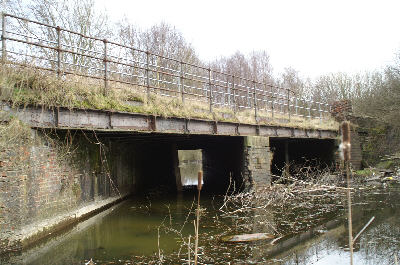
In its heyday, the branch had so much traffic that, when the railways were built, a dual tunnel had to be constructed for the canal (see photo, right).

Local vicar and canal enthusiast Rev David Long says, "This actually forms my parish boundary. Sadly, mining subsidence brought about its demise, and much of its line was subsequently obliterated by opencast working on Ince Moss at Strangeways."

Ince and Strangeways Branch Canal
Dual tunnel under railway embankment. Photo: David Long

The end of the Ince and Strangeways Branch came in 1918, when the lock that connected the branch with the main line of the canal was destroyed in a Zeppelin raid on the area. This is commemorated by a steel bench near the junction of the branch with the Wigan lock flight. [See photo] The bomb scored a direct hit on the only lock on the branch. The lock was subsequently abandoned and infilled, bringing about the final closure of the branch.

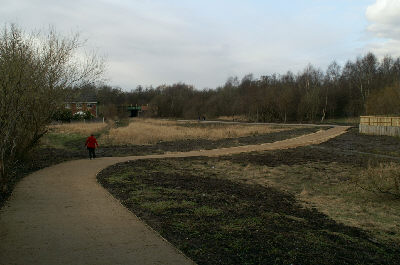
The line of the branch is not, however, entirely forgotten locally, as part of its route is being used for a new cycleway linking Leigh and Hindley with Wigan town centre (see photo, below left).

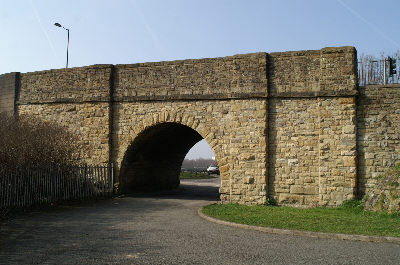
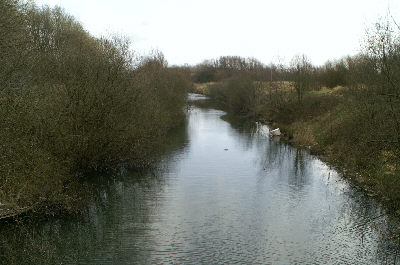
Parts of the route are still in water, although becoming encroached upon by tree growth (see photo at bottom of page and aerial view). Luckily there are no buildings on the line of the canal but a former canal bridge under Ince Green Lane is now used for a roadway - next to the appropriately named Canal Street! [See location]

Ince and Strangeways Branch Canal
Cycleway using part of the route. Photo: David Long
Ince and Strangeways Branch Canal
Former canal bridge under Ince Green Lane. Photo: David Long

The waterway played a key part in the area's development, claim historians.

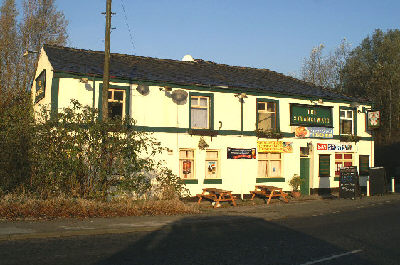
"The canal ended at an important interchange with tramways from coal mines around Hindley and Bickershaw," explains Joe Kerr, of the Friends Of Old Lancashire. "The Strangeways Hotel was built next to the canal basin. At first some people think this is a joke - you see 'Strangeways Hotel' was the nickname given to the prison in Manchester - but that really was the name of the pub here. It has recently been renamed The Paddock but, oddly, the lettering on the side of the building still says The Strangeways" [more]

"It could have become a very important link in the canal network," he reflected. "As Canal Mania took hold, there were plans to extend it through Bickershaw, Howe Bridge and Tyldesley, with a tunnel under Walkden to meet the Fletcher's Canal and connect with the Manchester Bolton and Bury Canal at Clifton Junction. This tunnel would have made use of existing canal tunnels that were part of the Duke of Bridgewater's mines. There were even plans for an elaborate underground coal wharf where coal could be loaded directly onto full-sized barges, reducing the cost of coal still further. However, an alternative link was built in 1820 by way of Poolstock, connecting with the Bridgewater Canal at Leigh, thus sidelining the Strangeways Branch and dooming it to obscurity."

Now members of Hindley Area History Association (HAHA) are keen to see this historic waterway remembered and even brought back to life.

The group is organising a meeting this morning for those from various organisations who are interested in forming a campaign group to promote the branch.

Anyone interested in being part of the new group should get in touch with HAHA before mid-day, or get in touch with Orla Lipof, the group's secretary.

Ince and Strangeways Branch Canal
Part of the branch is in water. Photo: David Long
Ince and Strangeways Branch Canal
The former Strangeways Hotel. Photo: David Long