Pennine Waterways News

Showing posts with label April. Show all posts

Monday, 1 April 2019

Which side will you be on?

If the political turmoil can be sorted and Britain leaves the EU, then there are proposals for Britain to withdraw from the regulatory powers of the European Navigation Directive.

Campaigners for the withdrawal from this Directive want Britain to set its own rules and standards. These cover a wide range of issues, from regulations for life rings to rules about red diesel.

One of the more controversial parts of the proposals is the plan for boats to pass each other on the left, rather than on the right as the rest of Europe does. A spokesman for the campaigners says that in Britain we proudly drive on the left hand side of the road, unlike countries in Europe, where they drive on the right, so it is only right that boaters should be able to assert Britain's independence by driving on the left hand side of the canal or river.

It is quite a big step and it will take people a while to get used to it, so it is planned to carry out the change in stages. Hire boats will be the first to change, possibly starting this summer, as the new rule can easily be introduced as part of the normal training given to hirers. Other boats will continue as they are for now, with the changeover coming into effect for them from early in 2020.

The Canal and River Trust's Brexit Officer, Anne Kerr, commented that people wanted to leave the European Union but it might take some time to untangle ourselves from the complex web of rules and regulations. "One of the first changes will be the abandonment of the European standard for horn signals. A lot of boaters don't even know what some of the current horn signals mean. Many boaters tell us they couldn't give two hoots about them."

Some of these changes were due to come into effect this morning but they will have to be delayed until Parliament makes its mind up about what kind of Brexit it wants.

Saturday, 1 April 2017

Standedge Tunnel to be re-named?

A proposal was announced this morning that the historic Standedge Tunnel, the longest canal tunnel in the country, is to get a new name.

The tunnel, on the Huddersfield Narrow Canal, could be re-named the Sir Patrick Stewart Tunnel in honour of Huddersfield's most famous actor son, known world-wide for his role in Star Trek

Patrick Stewart was born in 1940 in Mirfield, just outside Huddersfield. He started acting in 1966, the same year the original Star Trek series began. He went on to become a member of the Royal Shakespeare Company, yet it was his role as Captain Jean-Luc Picard in Star Trek: The Next Generation which won him global fame.

In 2004 Stewart was made Chancellor of the University of Huddersfield, which sits alongside the canal near Lock 1e. He was knighted in 2010.

The proposal for the canal tunnel to be named after him is to honour his fifty years of acting. Stewart admires the navvies who built the tunnel. "They boldly went where no navvies had gone before," he said. "It was an amazing enterprise."

He added, "When plans to re-open the canal were announced, it was dubbed 'The Impossible Restoration'. But I have often said 'Things are only impossible until they're not'."

William T Riker of the Canal and River Trust said, "When we first heard about the proposal to re-name the tunnel, we thought it was a joke but Sir Patrick is a well-loved personality in this area and we'd be fools to miss a chance like this. This is a special date for us. Now will never come again."

When asked his thoughts about the tunnel bearing his name Sir Patrick replied: "Let's make sure history never forgets the name. Make it so."
 

Friday, 1 April 2016

Penguins spreading across northern canals

Penguins are becoming an increasingly common sight on the canals of northern England. However, visiting boaters and walkers are often surprised to spot these endearing birds swimming in the canal or waddling along the towpath.

It is thought that the penguins were accidentally introduced to the area following an escape from a private zoo. The canal environment has obviously suited them as they have bred successfully and are spreading out along the northern waterways. Although penguins are usually associated with the cold seas of the Antarctic, they are quite common in the warmer equatorial waters around the Galapagos Islands, and they seem surprisingly at home in the temperate climate offered by the Leeds and Liverpool Canal.


Penguins on the streets of Skipton in search of food. (Photo: ritsch48 via Flickr)

As the numbers of the penguins has increased, they have started to become something of an attraction to visitors. At the beginning of April, as springtime arrives, the birds can be seen leaving the water and walking through the streets of Skipton, hoping to be fed fish and chips by willing tourists.

Paul Yolegg, whose appropriately-named narrowboat Polar Foil is currently moored in Skipton said: "I thought this must be a joke when I heard about it. It is not the kind of thing you expect to find in Yorkshire."

Canal & River Trust ornithologist Jess Kidding told us that this morning might be the best time to see this spectacle, as the penguins usually return to the water to cool down by mid-day.

She said that, although the birds are friendly enough, there was a risk that they could bite, and she warned eager visitors not to try to pick up a penguin.
 

Wednesday, 1 April 2015

Inclined Plane Plan for Leeds and Liverpool?

An exciting proposal has been made that would replace part of the notorious Wigan Lock Flight with an inclined plane boat lift.

It is believed that many boaters are put off visiting the Leeds and Liverpool Canal by the prospect of the 21 lock flight between the junction of the Leigh Branch and Wigan Top Lock. Many of the gates are heavy to operate and there are sometimes problems with low water levels, leaking gates, etc.

A scheme put forward suggests replacing the top thirteen locks with an inclined plane that would carry boats on cradles or in caissons mounted on rails. These 13 locks are fairly close together and the canal drops 118 feet (36 metres) in just one mile.


Example of an inclined plane using a cradle on the Elbląg Canal. Photo: Wsombeck at de.wikipedia

The plan would see two cradles running on a single track, with a passing place at the midway point. The cradles would be drawn by a cable. Each cradle would include a water tank that can be filled for the downward journey, so that the extra weight would help to pull the other cradle upwards, reducing the power of the motor required to haul the cables.


Example of an inclined plane with cable-hauled cradle on the Elbląg Canal. Photo: Wsombeck at de.wikipedia

At each end of the plane, the track would slope into the water so that boats can be floated on and off the cradles. It would only take around 20 to 30 minutes for a boat to travel the length of the incline, compared with the 2 hours or more taken to do the 13 locks.

There are a number of examples of systems like this operating successfully in Europe. Most of these inclined planes run in a straight line but there are examples of some that have slight curves built in, and the plane at Wigan would require two slight curves if it was to follow the existing line of the locks.


Example of a curved inclined plane at Dahme Umflutkanal. Photo: Botaurus Stellaris via Wikimedia Commons

The scheme could pay for itself over a longer period through savings in the cost of maintaining the 13 locks it would replace. Boaters would then only be faced with the 8 locks below Rose Grove, attracting more boaters to use the canal, bringing increased revenue for businesses along the route.

The inclined plane, as it would be the only one operational in Britain, could also become something of a tourist attraction in its own right and see tourists once again flocking to Wigan.

The idea is being promoted by The Wigan Incline Trust (T.W.I.T.) who are hoping for backing from local businesses which could benefit from a renewal of the area.

The head of the Canal and River Trust's Blue Sky Thinking section, Maureen Wring, said that this re-affirms the Trust's commitment to boaters. "We are calling it the Leeds and Liverpool Lockless Level Line Lift," she explained. "We hope there will be a trip boat giving tourists rides on the plane. Local tourism bosses are drawing up proposals for a Plane Incline Experience, or P.I.E. Wigan is famous for its pies."

However, Joe Kerr, of the Friends Of Old Lancashire, is not happy and feels the plane will change the character of the historic lock flight: “It will change the character of the historic lock flight,” he told us. “I am not happy.”

The plans are to be unveiled at an exhibition that will be open this morning until mid-day. For more details see here.

Note: The proposed inclined plane is not far from the Ince and Strangeways Branch Canal, the proposed reinstatement of which was featured here a few years ago.


There were a number of inclined plane boat lifts in Britain at one time. These are the remains of the Hay Incline on the Shropshire Canal at Coalport. Photo: Crispin Purdye via Wikimedia Commons

Tuesday, 1 April 2014

Arts Project extends to Musical Tunnels

Following the success of the hugely popular Locklines arts project, which has seen lines of poetry appear on lock gates, the Canal and River Trust is promoting a new project that will incorporate music into the canal experience.


Poetry on the beams of Lock 9e of the Huddersfield Narrow Canal.

In 2013 The Canal and River Trust surprised canal fans by appointing a Canal Laureate and forming a partnership with leading poets. Part of this project involved lines of poetry being engraved onto the balance beams of several locks where new gates were being fitted. There have also been canalside poetry events and poetry readings allowing the public to become involved.

The poetry project has proved so popular that, working with the Arts Council, the Canal and River Trust is developing ways to extend its arts outreach by creating musical experiences on the waterways.

Several tunnels, including Preston Brook and Foulridge in the north, are to be included in the project. Loudspeakers are to be positioned in ventilation shafts so that specially composed music can be heard echoing through the tunnels. Electrical power will be provided by solar panels and wind generators situated on the surface above the air shafts.


Impression of how the musical light show will appear to boaters.

As an additional feature to enhance the experience for boaters, coloured lighting is being installed to give a 'light show' where the colours will change in time with the music. The project will be launched at the beginning of April and, if it proves to be as popular as expected, could become a permanent feature of the waterways.

Ms Flora Lipo, the newly-appointed National Waterways Maestro, was very excited by the proposals. "I am very excited by the proposals," she commented. "This is the first time since Handel's Water Music was performed on the Thames that such an innovative integration of water and music has been explored. We are working with our partners, musical event organisers Sounding Bored, to put these fantastic proposals into operation."

Derbyshire narrowboat owner Melandra Castle is not impressed, though. "I am concerned about the lack of consultation," she complains. "This is the first we have heard of this proposal. It is another example of CRT turning the waterways into a giant theme park. They would be better spending the money on dredging."

However, Ms Lipo assures boaters that all the initial money will come from arts funding and the installation will be done at the same time as routine tunnel maintenance. Later on, volunteers will be invited to knit items which can be sold to raise funds to keep the project going through the 'Crochet a Crotchet' scheme.

Some live performances are also to be included in the project. Opera singer Dame Avril Fish will be in Standedge Tunnel this morning. She will travel in the CRT safety 'shadow' van through the adjacent disused railway tunnel and will serenade boaters as they pass the connecting adits. Ms Lipo reckons that the echoes in Britain's longest canal tunnel will be unbelievable. “Members of the public will be able to hear this incredible ethereal music from each end of the tunnel. You'd be a fool to miss this rare opportunity,” she added.

Sunday, 1 April 2012

Water from the North to go South

An innovative scheme to help solve the problems of canal users in the drought-hit Home Counties has been announced. Some canal reservoirs in Northern England have more water than is currently needed so water is to be moved by canal to the Grand Union Canal which has been experiencing a severe water shortage in recent months.

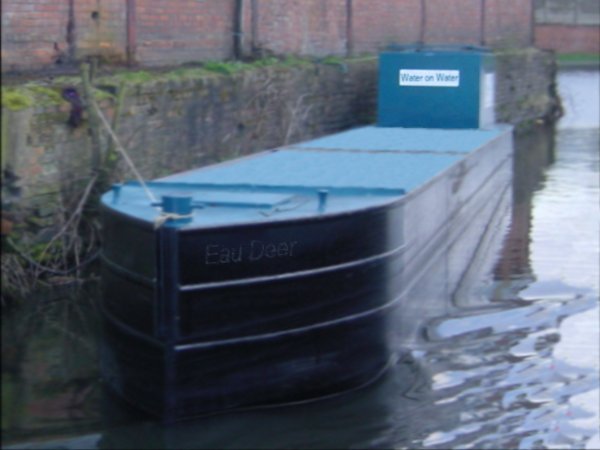
British Waterways has appointed contractor Water On Water to operate the scheme, which will begin on an experimental basis at the beginning of April.

A number of working narrowboats are being adapted by fitting them with large water-tight tanks which hold up to 20,000 litres of water. The boats will carry the water southwards by way of the Trent and Mersey Canal and the Northern Oxford Canal to the Grand Union Canal. They will climb the Marsworth lock flight to the Tring Summit where the water will be released. The Tring Summit has been suffering from a severe lack of water due to the falling levels of underground water tables in the area.

Billy Bowser, a spokesman for contractors Water On Water, said, "The scheme will enable British Waterways to maintain navigation across Tring Summit, a key link in the canal between London and the Midlands."


One of Water on Water's converted water tankers

Helen Highwater, whose boat has been marooned at Cowroast on the Tring Summit all winter said "Any additional water will be welcome. I don't care where it comes from or how they get it here. There have been stop planks in across the canal here for most of the winter. Anything's got to be better than that."

BW spokesperson Allie Sash revealed that they had been considering topping up the Tring summit level from the water point at Bulbourne, but the recently-announced hosepipe ban has sunk that idea. "We are delighted to be able to announce this innovative scheme to move water by boat," she said. "It uses water from Northern England where there are not the same water shortages as in the South. If the scheme is a success we will increase the amount of water we move south. There are not as many boats up there, either, so they don't need the water as much. It causes less disruption if we have to close a northern canal. It also helps to increase freight traffic on the canals, which many people have campaigned for."

However, critics are pointing out that the Marsworth locks use around 160,000 litres of water and it would require 8 boats to bring one lockful of water. Assuming the boats travelled in pairs this means that it would use 4 lockfuls of water to transport one lockful to the summit.

Mr Bowser admitted that some of the fine details were still to be sorted out but added that this was an experiment and the procedures would be reviewed to ensure the operation was effective.

"We are working with British Waterways scientists to develop a method of carrying concentrated water in our boats," added Mr Bowser. "It would require far fewer boats and simply needs to be diluted as it is put into the canal. It may sound far-fetched but the availability of up-to-date techniques means that this will be the right solution for today."

Friday, 1 April 2011

Waterway Charity - New Name and Logo Revealed

After much speculation, the name of the new waterways charity has finally been announced. The organisation is to be known as Waterways Environment Trust and the new logo has been revealed featuring the initials w e t in aqua blue lettering.

This has come as a surprise to many waterways groups which had favoured calling the charity British Waterways Trust, or simply keeping the name British Waterways.


A BW spokesman told us: "The new name reflects the fact that although the new trust would initially take over BW's waterways, it would eventually also include the navigations currently managed by the Environment Agency.

"The change of name will also signal a change of emphasis for the waterways. They will become "the People's Waterways" rather than just the Boaters' Waterways. We want everyone to feel ownership of their local canals and rivers.

"Research commissioned for Defra and British Waterways in 2010 indicated that the general public are very likely to donate to the new waterway charity and we feel they will be more willing to contribute if they perceive that the waterways are not just the private domain of a privileged few who could afford boats.

"Also, at this time of severe financial limitations, it is highly likely that some sections of waterway will have to be abandoned to navigation if we are no longer in a position to be able to maintain them safely. Therefore we want to stress the "Environment" aspect where a greater priority is given to wildlife as some canals move towards a possible future without boats."

Several boaters' organisations have expressed concern at these comments, although some are privately acknowledging that some high-maintenance waterways may have to be sacrificed in order to keep the rest of the network open.

There has also been criticism of the new logo, too. It had been hoped by many that the new name might be sufficiently similar to British Waterways that the existing logo could be retained, as this would avoid the cost of re-painting thousands of signs and notices and of issuing staff with new uniforms.

The spokesman proudly told us the logo included a black and white lock gate, reflecting BW's present identity, as well as a wave design. When questioned about the use of the initials, which spelt "wet" the spokesman replied: "Well, that's what waterways are! We are thinking about launching a publicity campaign with a slogan like 'Get Wet!' We think that would be rather snappy and appeal to the general public."

BW has paid an undisclosed amount to a design agency to produce the new logo. However, a spokesman for one of the main boaters' organisations described it as "naff" and was less than enthusiastic about the new name. "This whole thing is a joke!" he said. "It's the sort of story that appears at this time of year, like the first cuckoo! The BW logo is instantly recognisable and you'd be a fool to want to change it."

Please click the Comment link below if you would like to have your say about this story. For further information about Waterways Environment Trust, please click here.

A Less Leaky Leeds and Liverpool?

British Waterways is rolling out an innovative approach to water management which it hopes will help solve the problems of the north's leakiest canal.

British Waterways is determined to prevent a repeat of last year's major stoppage on the Leeds and Liverpool Canal, when 60 miles of waterway from Wigan to Garsgrave was closed through shortage of water.
 

Foulridge Upper Reservoir. Photo: Richard Carpenter
 
The low rainfall last summer was exacerbated by long-standing problems of water leaking from the canal where it contours round the hillsides between Greenberfield and Bank Newton, turning adjacent fields into quagmires while the canal ran out of water.

This year, following extensive testing, a thickening agent is being added to water entering the canal's summit pound at Foulridge. The additive, which have been found to be completely harmless to fish and wildlife, starts a process of bonding water molecules together to form a weak gel. As the treated water is thicker than normal, it is less likely to seep through leaky embankments. BW estimates that leaks can be reduced by 85% in this way. This will help to preserve the precious water resources entering the canal and, hopefully, help to avoid future closures.

However, not everyone is happy with this new initiative. Some boaters are complaining that the thicker water is reducing the speed of their boats through the water, increasing journey times as well as increasing their diesel consumption.

A BW spokesman accepted that fuel consumption may be increased but pointed out that the thicker water led to smaller bow waves, reducing erosion of canal banks. BW also pointed out that the additive has certain anti-freeze properties meaning that the water is less likely to turn to ice in the winter, thus enabling boats to be on the move for more weeks than normal.
 

Greenbank near East Marton
 
It is understood that one of the principal ingredients in the additive is corn starch, commonly used for thickening gravy and soup, and harmless to wildlife.

Experiments last year found that simply using custard powder, which contains corn starch, worked very well but tended to turn the water a yellow colour. However, this discolouration could be reduced by adding a powder made from dried rhubarb. This powder has been developed at BW's workshops at Stanley Ferry, inside Yorkshire's famous "Rhubarb Triangle". The idea of combining rhubarb and custard in this way was inspired by the Tom Pudding, the well-known local delicacy much favoured as a dessert by Yorkshire's boatmen.

Although BW is confident that the additive will help reduce water loss, they seem unsure as to whether boaters could experience any unexpected side effects. BW spokeswoman Rose Grove said they will begin introducing the thickening agent into the summit pound at the start of April and warned boaters in the area to check the date to make sure that they are not caught out.

Thursday, 1 April 2010

Falling Bollards Answer To Overstaying?

As this year's boating season gets under way there could be good news for those of you who have ever arrived by boat at a popular location only to find that there is nowhere to moor. Several new solutions are currently being tried out at popular mooring locations to try to ensure that boaters don't stay too long and that moorings are freed up for visiting boaters.

At Castlefield, in Manchester, the Bridgewater Canal Company is working with a company that specialises in "rising bollards" (that prevent cars driving into pedestrianised areas) to develop a special "falling bollard" for use alongside canals.
[Click on image to see larger version. Click Back button to return here.]

Experimental bollards at Castlefield
When a boat arrives at a mooring, the boater puts the ropes around the bollards and ties back onto the boat. The bollards are tall enough to prevent passers-by lifting the ropes off. Sensors on each bollard detect when a boat is attached. After the permitted mooring time has elapsed, the bollards will automatically retract into the ground. The ropes will then have nothing to attach to allowing the boat to drift away.

"We are convinced that boaters will not want this to happen and will ensure that they move on before the time limit expires," explained Francis Egerton for the canal company. "The Bridgewater Canal has always been a leader in the waterways sphere and we believe this is the first time an innovative solution such as this has been used."

Meanwhile BW is getting ready to install experimental parking meters at busy moorings at several locations on its canals. Popular moorings such as Marple, Lancaster, Skipton and Sheffield are thought to be included.

BW spokesman Sidd Finch said: "We have found that a system of paying for moorings at Llangollen has worked well in ensuring that there is a frequent turnover of moorers. The use of mooring meters will build on that successful experience but will eliminate the need to have someone on hand to collect mooring fees.

"They will look like normal parking meters, but will work on days rather than hours. Instead of looking at your watch, you will need to pay careful attention to the date," he explained.

Some boaters were unhappy with the falling bollards in Manchester, however. "We had hoped for something better than this," complained boater Joel Pirak. "We feel they are a bit of a let down." He found his narrowboat Parasol of Idyl adrift after the bollards retracted prematurely. "They haven't gone down well with other boaters, either," he added.

Francis Egerton said "This was just a first attempt so we will need to iron out any problems that arose. The trial ends at midday but we are confident that the experiment will have been a success and that these bollards will appear at popular mooring honeypots all over the country."

(Boaters wishing to learn more about BW's mooring meter proposals should contact Sidd Finch.)

Wednesday, 1 April 2009

New Hope for Forgotten Canal?

Canal enthusiasts and historians hope that a long lost branch of the Leeds and Liverpool Canal could once again see the light of day.
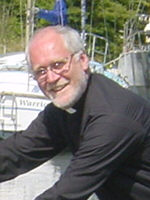
David Long
Rev David Long
The Ince and Strangeways Branch left the Wigan lock flight between the 2nd and 3rd locks and ran in a south-easterly direction through Ince to a terminal basin serving collieries at Strangeways, on the edge of Hindley.

In its heyday, the branch had so much traffic that, when the railways were built, a dual tunnel had to be constructed for the canal (see photo, right).

Local vicar and canal enthusiast Rev David Long says, "This actually forms my parish boundary. Sadly, mining subsidence brought about its demise, and much of its line was subsequently obliterated by opencast working on Ince Moss at Strangeways."
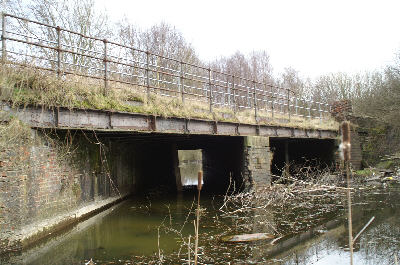
Ince and Strangeways Branch Canal
Dual tunnel under railway embankment. Photo: David Long

The end of the Ince and Strangeways Branch came in 1918, when the lock that connected the branch with the main line of the canal was destroyed in a Zeppelin raid on the area. This is commemorated by a steel bench near the junction of the branch with the Wigan lock flight. [See photo] The bomb scored a direct hit on the only lock on the branch. The lock was subsequently abandoned and infilled, bringing about the final closure of the branch.

The line of the branch is not, however, entirely forgotten locally, as part of its route is being used for a new cycleway linking Leigh and Hindley with Wigan town centre (see photo, below left).

Parts of the route are still in water, although becoming encroached upon by tree growth (see photo at bottom of page and aerial view). Luckily there are no buildings on the line of the canal but a former canal bridge under Ince Green Lane is now used for a roadway - next to the appropriately named Canal Street! [See location]

Ince and Strangeways Branch Canal
Cycleway using part of the route. Photo: David Long
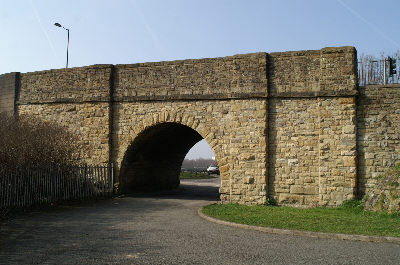
Ince and Strangeways Branch Canal
Former canal bridge under Ince Green Lane. Photo: David Long

The waterway played a key part in the area's development, claim historians.

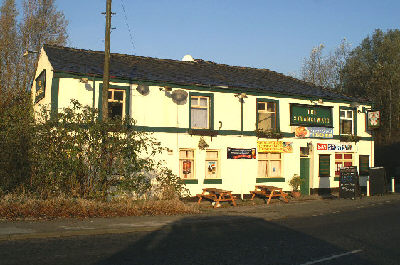
"The canal ended at an important interchange with tramways from coal mines around Hindley and Bickershaw," explains Joe Kerr, of the Friends Of Old Lancashire. "The Strangeways Hotel was built next to the canal basin. At first some people think this is a joke - you see 'Strangeways Hotel' was the nickname given to the prison in Manchester - but that really was the name of the pub here. It has recently been renamed The Paddock but, oddly, the lettering on the side of the building still says The Strangeways" [more]

"It could have become a very important link in the canal network," he reflected. "As Canal Mania took hold, there were plans to extend it through Bickershaw, Howe Bridge and Tyldesley, with a tunnel under Walkden to meet the Fletcher's Canal and connect with the Manchester Bolton and Bury Canal at Clifton Junction. This tunnel would have made use of existing canal tunnels that were part of the Duke of Bridgewater's mines. There were even plans for an elaborate underground coal wharf where coal could be loaded directly onto full-sized barges, reducing the cost of coal still further. However, an alternative link was built in 1820 by way of Poolstock, connecting with the Bridgewater Canal at Leigh, thus sidelining the Strangeways Branch and dooming it to obscurity."

Now members of Hindley Area History Association (HAHA) are keen to see this historic waterway remembered and even brought back to life.

The group is organising a meeting this morning for those from various organisations who are interested in forming a campaign group to promote the branch.

Anyone interested in being part of the new group should get in touch with HAHA before mid-day, or get in touch with Orla Lipof, the group's secretary.
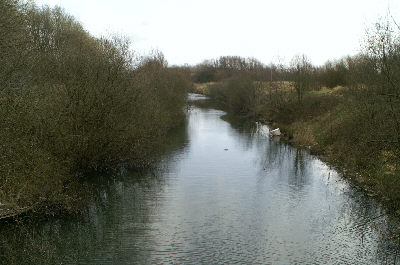
Ince and Strangeways Branch Canal
Part of the branch is in water. Photo: David Long
Ince and Strangeways Branch Canal
The former Strangeways Hotel. Photo: David Long

Tuesday, 1 April 2008

Whale Swims up Ship Canal

Great excitement was created at the weekend when a whale was spotted swimming up the Manchester Ship Canal!

Ship Canal
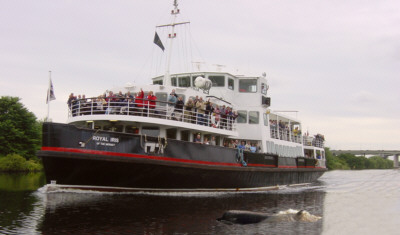
Passengers on the Royal Iris line the rails to see the whale.
It was first spotted swimming under Runcorn Bridge on Sunday morning. Onlookers followed it along the shore past Old Quay bridge, but soon lost track of it as it moved onto a rural section of the waterway with no towpath.

Trippers aboard the Mersey Ferry "Royal Iris", on one of its regular trips along the canal, were able to enjoy the spectacle as the ship slowed down to a crawl as it passed the whale.

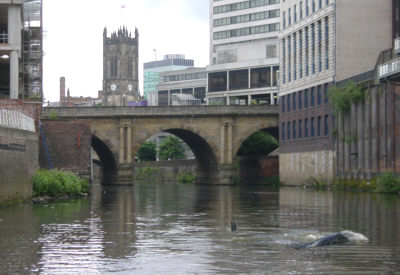
Later in the day the whale was seen passing the Lowry Centre at Salford Quays before swimming up the River Irwell through Manchester city centre.

As excited spectators rushed from bridge to bridge to catch a glimpse of the wayward whale, it began heading back downstream.

The whale is thought to have been a bottle-nosed whale about 15 feet long. Marine life experts think that the whale, which normally lives in deep water, may have become disorientated during the recent wintry weather.

Ship Canal
The whale was sighted on the River Irwell in Manchester.
Members of the British Divers Marine Life Rescue were monitoring the whale's progress but were not unduly concerned. "As the Ship Canal has deep water right to the sides there was no risk of the whale grounding itself, so we just waited for it to find its own way back to sea," explained rescue expert Joe Kerr. "Whales often swim up rivers in Britain, but we have never seen one on the Ship Canal. This must be the first!"

The whale was last spotted in the evening, near Ellesmere Port, swimming across a wide area known as Flair Pool, heading back towards the Mersey Estuary.