British Waterways has appointed contractor Water On Water to operate the scheme, which will begin on an experimental basis at the beginning of April.
A number of working narrowboats are being adapted by fitting them with large water-tight tanks which hold up to 20,000 litres of water. The boats will carry the water southwards by way of the Trent and Mersey Canal and the Northern Oxford Canal to the Grand Union Canal. They will climb the Marsworth lock flight to the Tring Summit where the water will be released. The Tring Summit has been suffering from a severe lack of water due to the falling levels of underground water tables in the area.
Billy Bowser, a spokesman for contractors Water On Water, said, "The scheme will enable British Waterways to maintain navigation across Tring Summit, a key link in the canal between London and the Midlands."
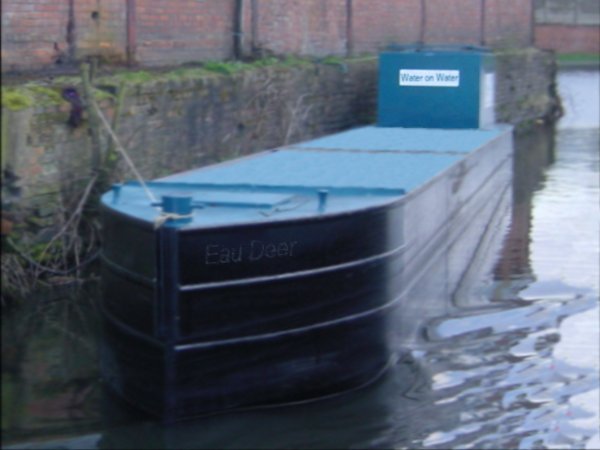
One of Water on Water's converted water tankers
Helen Highwater, whose boat has been marooned at Cowroast on the Tring Summit all winter said "Any additional water will be welcome. I don't care where it comes from or how they get it here. There have been stop planks in across the canal here for most of the winter. Anything's got to be better than that."
BW spokesperson Allie Sash revealed that they had been considering topping up the Tring summit level from the water point at Bulbourne, but the recently-announced hosepipe ban has sunk that idea. "We are delighted to be able to announce this innovative scheme to move water by boat," she said. "It uses water from Northern England where there are not the same water shortages as in the South. If the scheme is a success we will increase the amount of water we move south. There are not as many boats up there, either, so they don't need the water as much. It causes less disruption if we have to close a northern canal. It also helps to increase freight traffic on the canals, which many people have campaigned for."
However, critics are pointing out that the Marsworth locks use around 160,000 litres of water and it would require 8 boats to bring one lockful of water. Assuming the boats travelled in pairs this means that it would use 4 lockfuls of water to transport one lockful to the summit.
Mr Bowser admitted that some of the fine details were still to be sorted out but added that this was an experiment and the procedures would be reviewed to ensure the operation was effective.
"We are working with British Waterways scientists to develop a method of carrying concentrated water in our boats," added Mr Bowser. "It would require far fewer boats and simply needs to be diluted as it is put into the canal. It may sound far-fetched but the availability of up-to-date techniques means that this will be the right solution for today."