Pennine Waterways News

Friday, 1 April 2011

Waterway Charity - New Name and Logo Revealed

After much speculation, the name of the new waterways charity has finally been announced. The organisation is to be known as Waterways Environment Trust and the new logo has been revealed featuring the initials w e t in aqua blue lettering.

This has come as a surprise to many waterways groups which had favoured calling the charity British Waterways Trust, or simply keeping the name British Waterways.


A BW spokesman told us: "The new name reflects the fact that although the new trust would initially take over BW's waterways, it would eventually also include the navigations currently managed by the Environment Agency.

"The change of name will also signal a change of emphasis for the waterways. They will become "the People's Waterways" rather than just the Boaters' Waterways. We want everyone to feel ownership of their local canals and rivers.

"Research commissioned for Defra and British Waterways in 2010 indicated that the general public are very likely to donate to the new waterway charity and we feel they will be more willing to contribute if they perceive that the waterways are not just the private domain of a privileged few who could afford boats.

"Also, at this time of severe financial limitations, it is highly likely that some sections of waterway will have to be abandoned to navigation if we are no longer in a position to be able to maintain them safely. Therefore we want to stress the "Environment" aspect where a greater priority is given to wildlife as some canals move towards a possible future without boats."

Several boaters' organisations have expressed concern at these comments, although some are privately acknowledging that some high-maintenance waterways may have to be sacrificed in order to keep the rest of the network open.

There has also been criticism of the new logo, too. It had been hoped by many that the new name might be sufficiently similar to British Waterways that the existing logo could be retained, as this would avoid the cost of re-painting thousands of signs and notices and of issuing staff with new uniforms.

The spokesman proudly told us the logo included a black and white lock gate, reflecting BW's present identity, as well as a wave design. When questioned about the use of the initials, which spelt "wet" the spokesman replied: "Well, that's what waterways are! We are thinking about launching a publicity campaign with a slogan like 'Get Wet!' We think that would be rather snappy and appeal to the general public."

BW has paid an undisclosed amount to a design agency to produce the new logo. However, a spokesman for one of the main boaters' organisations described it as "naff" and was less than enthusiastic about the new name. "This whole thing is a joke!" he said. "It's the sort of story that appears at this time of year, like the first cuckoo! The BW logo is instantly recognisable and you'd be a fool to want to change it."

Please click the Comment link below if you would like to have your say about this story. For further information about Waterways Environment Trust, please click here.

A Less Leaky Leeds and Liverpool?

British Waterways is rolling out an innovative approach to water management which it hopes will help solve the problems of the north's leakiest canal.

British Waterways is determined to prevent a repeat of last year's major stoppage on the Leeds and Liverpool Canal, when 60 miles of waterway from Wigan to Garsgrave was closed through shortage of water.
 

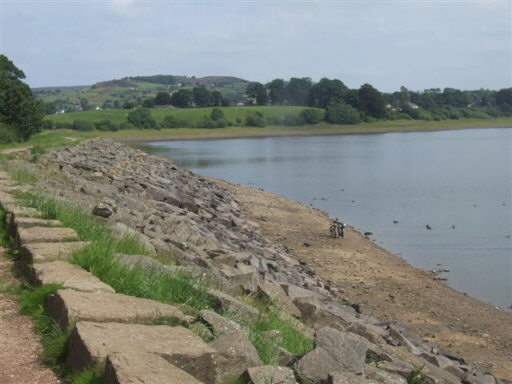
Foulridge Upper Reservoir. Photo: Richard Carpenter
 
The low rainfall last summer was exacerbated by long-standing problems of water leaking from the canal where it contours round the hillsides between Greenberfield and Bank Newton, turning adjacent fields into quagmires while the canal ran out of water.

This year, following extensive testing, a thickening agent is being added to water entering the canal's summit pound at Foulridge. The additive, which have been found to be completely harmless to fish and wildlife, starts a process of bonding water molecules together to form a weak gel. As the treated water is thicker than normal, it is less likely to seep through leaky embankments. BW estimates that leaks can be reduced by 85% in this way. This will help to preserve the precious water resources entering the canal and, hopefully, help to avoid future closures.

However, not everyone is happy with this new initiative. Some boaters are complaining that the thicker water is reducing the speed of their boats through the water, increasing journey times as well as increasing their diesel consumption.

A BW spokesman accepted that fuel consumption may be increased but pointed out that the thicker water led to smaller bow waves, reducing erosion of canal banks. BW also pointed out that the additive has certain anti-freeze properties meaning that the water is less likely to turn to ice in the winter, thus enabling boats to be on the move for more weeks than normal.
 

Greenbank near East Marton
 
It is understood that one of the principal ingredients in the additive is corn starch, commonly used for thickening gravy and soup, and harmless to wildlife.

Experiments last year found that simply using custard powder, which contains corn starch, worked very well but tended to turn the water a yellow colour. However, this discolouration could be reduced by adding a powder made from dried rhubarb. This powder has been developed at BW's workshops at Stanley Ferry, inside Yorkshire's famous "Rhubarb Triangle". The idea of combining rhubarb and custard in this way was inspired by the Tom Pudding, the well-known local delicacy much favoured as a dessert by Yorkshire's boatmen.

Although BW is confident that the additive will help reduce water loss, they seem unsure as to whether boaters could experience any unexpected side effects. BW spokeswoman Rose Grove said they will begin introducing the thickening agent into the summit pound at the start of April and warned boaters in the area to check the date to make sure that they are not caught out.